
“Breaking the fourth wall” is one of the most fascinating storytelling techniques used in movies, TV shows and theater. But what exactly does it mean, and why does it feel so surprising when a character suddenly talks directly to the audience? To understand this, we need to go back to its origins in traditional stage design and explore how this invisible barrier became one of the most creative tools in modern storytelling.
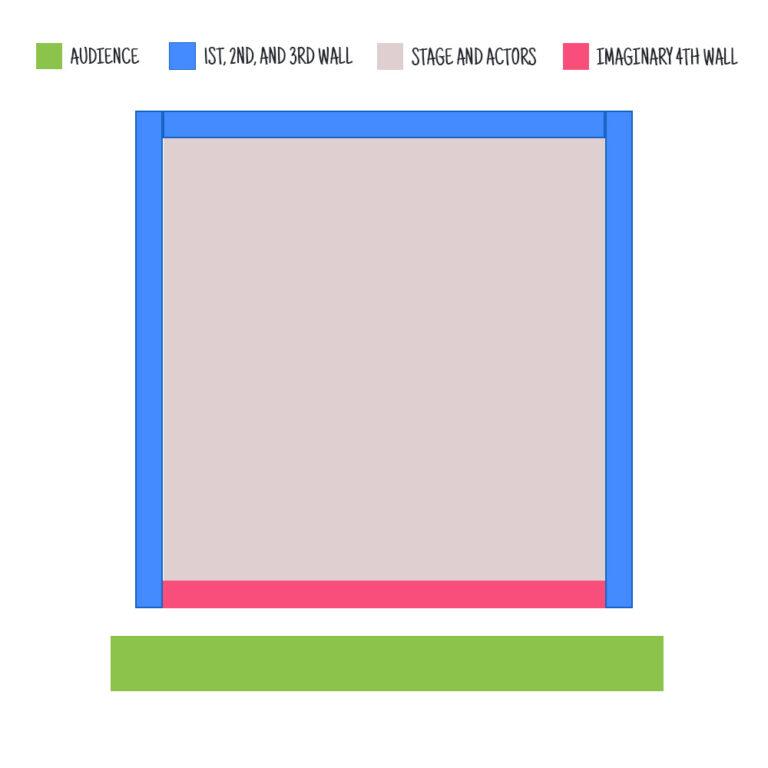
The term “Breaking the Fourth Wall” came from the physical layout of a traditional theatre stage.
The Three Walls
In a typical stage set designed to look like a room (called a “box set”), there are three physical walls: the back wall and the two side walls (left and right).
The Fourth Wall
The fourth wall is the imaginary, invisible barrier that separates the stage and the actors from the audience. The convention is that actors behave as if this wall is solid and that they cannot see the audience watching them; meanwhile, the audience temporarily forgets the real world and immerses themselves in the world of the play they are watching.
Breaking It
When a character directly faces or talks to the audience, or looks straight at the camera in a movie/TV show, or acknowledges the presence of the audience, they are said to be “breaking” or crossing the imaginary fourth wall, effectively destroying the illusion of the fictional world.
Historical Context
This concept is often associated with the 18th-century French philosopher and critic Denis Diderot, who suggested in 1758 that actors should:
“Imagine a huge wall across the front of the stage, separating you from the audience, and behave exactly as if the curtain had never risen.”
This idea became an established convention with the rise of realism and naturalism in 19th-century theater. Because of this, directly addressing the audience (which was common in older forms like Shakespearean soliloquies) started to be seen as a deliberate, dramatic, or comedic technique. In other words, a “breaking” of that convention.
Breaking the Fourth Wall in Movies
Here are some cool and memorable fourth-wall breaks in movies – some funny, some clever, all iconic.
All Deadpool Movies
Deadpool’s signature trait is that he directly talks to the audience, makes pop culture references, and acknowledges that he is a character in a movie, comic, or video game. This technique is an integral part of his films, often used with humor and meta-commentary. However, there are strict rules about who is allowed to do this. According to the directors and Ryan Reynolds, only Deadpool is allowed to break the fourth wall, based on their specific system and rules for these movies.

Deadpool: “Oh, hello. I know, right? Whose balls did I have to fondle to get my very own movie? I can’t tell you, but it does rhyme with “Polverine.“
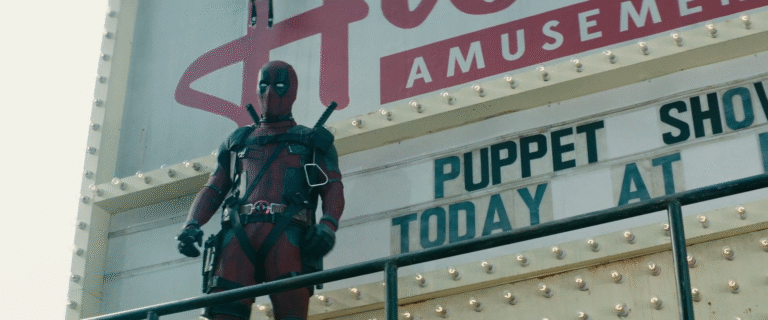
Deadpool: “X-Force is just a marketing tool designed by Fox executives to keep Josh Brolin employed.“

Nicepool: “Ah, that’s funny. I can gently tap the fourth wall too – ‘The Proposal.’“
Ferris Bueller’s Day Off
The main character, Ferris, talks directly to the audience, looks at the camera, and shares his thoughts and plans with viewers. This narrative device pulls the audience into his perspective, makes his plans feel more personal, and also serves as a key element of the film’s comedic style. One example is the post-credit scene where Ferris tells the audience that the movie is already over and they can go home.
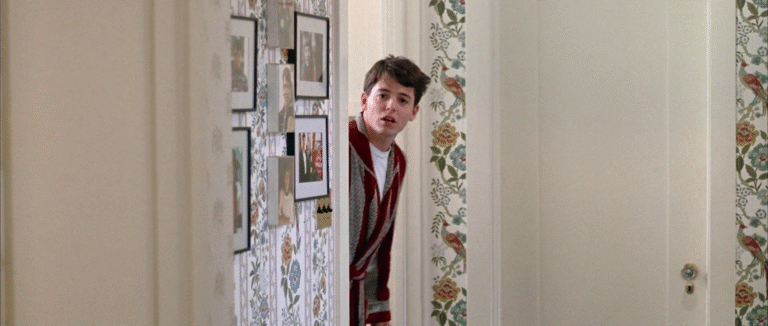
Ferris: “You’re still here? It’s over. Go home. Go.“
This scene was also parodied in the movie Deadpool.
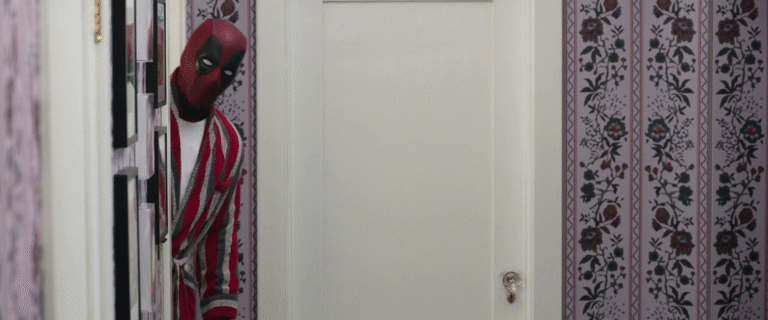
Deadpool: “You’re still here? It’s over. Go home. Oh, you’re expecting a teaser for Deadpool 2. Well, we don’t have that kind of money. What are you expecting? Sam Jackson to show up? With an eye patch and a saucy little leather number? Go. Go. Oh. But I can tell you one thing, and it’s a bit of a secret. For the sequel, we’re gonna have Cable. Amazing character. Bionic arm, time travel. We have no idea who we’re gonna cast yet, but it could be anybody. Just need a big guy with a flat top. Could be Mel Gibson, Dolph Lundgren… Keira Knightley. She’s got range. Who knows. Anyway, big secret. Shh… Oh, and don’t leave your garbage all lying around. It’s a total dick move. Go.“
Fight Club
Fight Club breaks the fourth wall using several deliberate techniques. One of the most popular is when the narrator points out the cigarette burn on the film itself. These moments directly address the audience and remind them to recognize the film as a manufactured product, aligning with the movie’s theme of questioning control and structure.
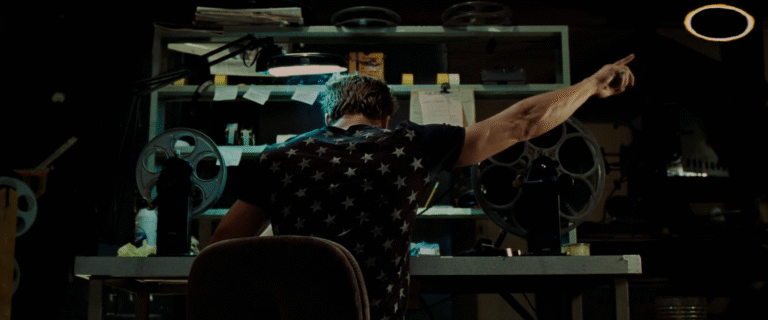
Narrator: “See, a movie doesn’t come all on one big reel. It comes on a few. So someone has to be there to switch the projectors at the exact moment that one reel ends and the next one begins. If you look for it, you can see these little dots come into the upper right-hand corner of the screen. In the industry, we call them ‘cigarette burns.’ That’s the cue for a changeover. He flips the projectors, movie keeps right on going, and nobody in the audience has any idea.“
Annie Hall
In the movie Annie Hall, breaking the fourth wall is a central, postmodern narrative device used by Woody’s character, Alvy Singer, to talk directly to the audience, give commentary on his life and relationships, and blur the line between fiction and reality. This approach makes the audience accomplices to his experiences and gives deeper insight into his neurotic character. One example is the scene where Alvy and Annie are in line for a movie. Alvy gets irritated by the opinion of the man behind him. He faces the camera and complains, then pulls the real Marshall McLuhan from off-camera to personally refute the man’s incorrect claim.
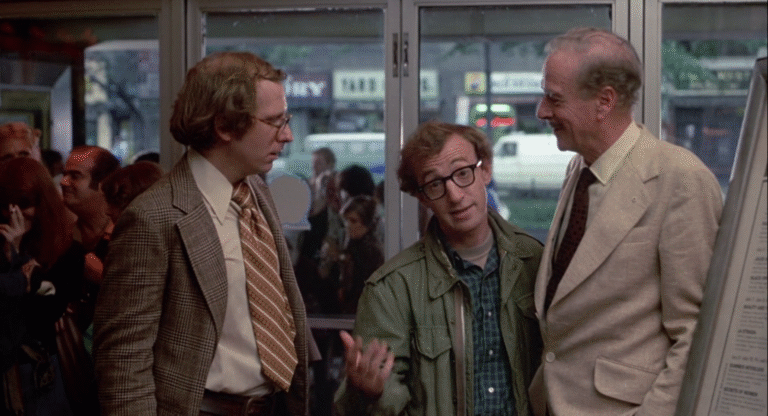
Alvy Singer: “What do you do when you get stuck in a movie line with a guy like this behind?“
Guy: “Why can’t I give my opinion? It’s a free country.“
Alvy Singer: “Do you have to give it so loud? Aren’t you ashamed to pontificate like that? The funny part is, you don’t know anything about Marshall McLuhan.“
Guy: “Really? I happen to teach a class at Columbia called TV, Media and Culture. So I think my insights into Mr. McLuhan have a great deal of validity.“
Alvy Singer: “Oh, do you? That’s funny, because I happen to have Mr. McLuhan right here. Just let me… Come over here a second.“
Marshall McLuhan: “I heard what you were saying. You know nothing of my work. You mean my whole fallacy is wrong. How you ever got to teach a course in anything is totally amazing.“
Alvy Singer: “Boy, if life were only like this!“
Spaceballs
Spaceballs, directed (and starred in) by the master of meta-comedy Mel Brooks, heavily abuses fourth-wall breaking for comedic effect. One famous example is when the characters watch the movie itself, “Spaceballs: The Movie”, on an instant cassette.
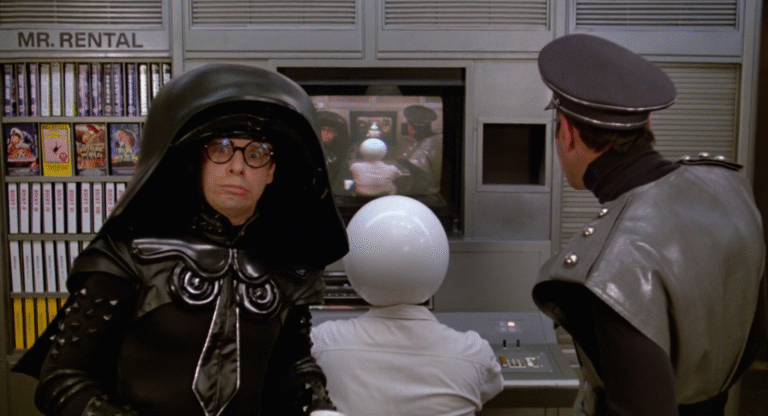
Colonel Sandurz: “Pardon me, sir. I have an idea. Corporal, get me the video cassette of Spaceballs: The Movie.“
Corporal: “Yes, sir. ‘The Producers, Twelve Chairs, Blazing Saddles, Young Frankenstein.“
Lord Dark Helmet: “Colonel Sandurz, may I speak with you, please?“
Colonel Sandurz: “Yes, sir.“
Lord Dark Helmet: “How can there be a cassette of Spaceballs: The Movie? We’re still in the middle of making it.“
Colonel Sandurz: “True, sir. There’s been a new breakthrough in home video marketing.“
Lord Dark Helmet: “There has?“
Colonel Sandurz: “Yes. Instant cassettes. They’re out in stores before the movie is finished.“
Lord Dark Helmet: “No.“
Corporal: “Here it is, sir! Spaceballs.“
MCU 4th Wall Breaks
Here is a compilation of fourth-wall breaks in the Marvel Cinematic Universe from the official Marvel Entertainment YouTube channel.
Bonus: Breaking 16 Walls
In the movie Deadpool, there’s a scene where Deadpool is talking to the audience (breaking the fourth wall), then he flashes back to Blind Al and talks to the audience again inside the flashback (another fourth-wall break), which led him to say:
“Fourth-wall break inside a fourth-wall break. That’s like 16 walls.”
Some people say it should actually be a 64-wall breaks, because after mentioning the 16 walls, he also referenced Batman and Robin (from the DC Universe), which is another fourth-wall break. Here’s the clip for your reference.